Gufodotto would like you to read these:

Showing posts with label science. Show all posts

Monday, August 04, 2008

Science for the masses. In Italian

A new blog I just happened to strike on, while reading The Loom (which, if you don't know, recently left Seed's ScienceBlogs for Discover magazine.

It's called "i divagatori scientifici", and looks like the guy has very wide interests. For the moment the number of posts is on the low side but hey... You can't have it all...

I'll stick it in my blog roll.

Next: Who on Earth keeps visiting this blog?

Friday, April 25, 2008

Microcosm is out!!!

So, if you really want to make me a present, well, you know my address don't you?

I'd be happy with an E. Coli plush toy, if you wish...


The author is touring the US, so if you happen to be close to one of his presentation, please go, as he's a really science writer. The best one around, I dare say.

Wednesday, March 26, 2008

My next steps.

I am toying with the idea of applying for research position in the anti-microbial, or generally anti-infective area.

The reasons? As far as I know, targets are easier to work with, more specifically, proteins are easier to Xtallize so that Structure-based drug design actually has some chance to work. Well, at least there's some material to start from. second, and most importantly, there is a resurgence of such diseases all over the world.

On the converse, though, big [pharma seems to have dropped this field as few doses of an antifungal or anti-viral are less remunerative than the long term treatment of a mentally or metabolically ill patient. But frankly, I don't like that area. It may be challenging, but also gets frustrating when your animal models have very limited analogy with the human condition.

One withdraw of such a coice is that such research positions are mainly available from small companies, and this means (ouch!) smaller salaries too. On the good side though, I'll be able to wear more than one hat, the environment will be more dynamic, and I may grow quicker, if I play my card well.

Well, good luck to me... Now, let's go and hunt down some bacteria!!!

Tuesday, March 25, 2008

Richard Dawkins goes to the movies with PZ Myers


They went together to a free (as in beer, not as in speech) pre-screening of Expelled, a documentary about the lack of controversy between Evolutionary theory and IDiocy.

Anyway, PZ Myers was singled out by the security guards and asked to leave, whereas the much less illustrious Tricky Dicky was let in.


He's said to have gone berserk half-way in the projection, dismembering several spectators before being put to rest by the bite of an intelligently designed bull-mastiff. Lol. What a quintessentially english gentleman...

Get the full story here.

Tuesday, March 11, 2008

Evolution of foods

Some scientist have analysed the evolution of recipes through time in four different cookbooks, and concluded that traditional cuisine evolve quite slowly, mosty because special ingredient are difficult to replace.

I wonder if some sort of tree of cooking could be built from gastronomic traditions of various populations and how it would relate to migrations, either known or presumed to have happened before historical records began...

update: in fact, since recipes are memes, as in the original definition of Dawkins, it may really turn out to be an interesting exercise...

Wednesday, February 20, 2008

Have an Ice Day!!!


Pseudomonas syringae is an extremely interesting bacterium, which I discovered reading Olivia Judson's latest post on cloud-dwelling bacteria.

Usually, plants growing in cold regions use special chemicals as anti-freeze. This bacterium, though, secretes Ice Nucleation-active proteins to make ice crystals grow at temperatures as high as -2C. The crystals cause damage to cell walls of plants, and the bacterium vacuums up the nutrients released.

So, they use ice crystals as straw, although the name "syringae" doesn't come from there. Rather, it comes from the plants they were isolated from at first:

It is named after the lilac tree (Syringa vulgaris), from which it was first isolated[2]
(from the wikipedia)

and always on the theme of vampires from the cold, the new Penny Arcade strip is out!

Tuesday, February 19, 2008

Double blind scientific review

John Denney over at Evilutionary Biologist makes an interesting point: How often and how much knowing the reputation of the author of a paper influences the opinion we get from reading it?

The discussion was sparked by a piece on the journal Nature.

Would it not be better if the review process was double blinded, as it happens in the case of clinical trials of new drugs?


I do happen to think it is a good idea too.

It is certainly possible to guess who the author of the paper is from the subject, his writing style and (possibly) the amount of self-citations(!).

But one more hurdle to accepting a paper as a gold nugget just because it's been crapped up (down) by Dr Eminent can't hurt, can he?

I am personally in the middle of the final touches to my paper before submission - and I think that another good point of it is that reviewers who will happen to read it (if it gets accepted for review, that is) will not know my name so they will not black list me for future collaborations.

Oh, come on, a bit of self-confidence, Dr Fenu...

Monday, February 11, 2008

Boredom...

I am bored. I should correct my paper and get it finally submitted, but it's stronger than me and can't just decide whether to accept the corrections suggested by a co-author or not...

Scientific publications are so troublesome (at least for me) that I am almost tempted to give up on this career and pursuit a job in finance (lol, not really) or any other field where you are not required to write up your stuff. It's not that I don't want to share, I am more than happy of that and well willing to talk about my work. It's just that I am very very bad at writing up, possibly because none of the endless literature courses during my school in Italy ever concentrated on the basic of good and understandable writing.

IYou can see it from how long the previous phrase was. In Italy long phrases, branching in two or three nested level get you a premium by the professor. Ow, all this sucks. I wish I was like many of my colleagues, with a much wider cultural span but much more 'able' to do the job... They're like very sharp knives, good to cut steaks, whereas I am the jack of all knives (d`uh!) - with multiple skills but none up to an acceptable level.

Enough complaining. I'm leaving work early to discover the joys of having a Makro card - Then I will try to correct the paper in the evening at home, with the advantage of Word XP which lets you see the correction and the original at once...

see you soon...

Wednesday, January 30, 2008

Infrared photography

I recently heard on the naked science podcast that pointing a remote control to my camera phone I could see it flashing, because the sensitivity of the CCD inside extends to the near-IR.

It wrks! And it gave me a terrible case of cognitive dissonance to look at the remote through the screen, then with the naked eye, then with the screen again and so on. I just could not believe it, PhD in physical chemistry notwithstanding my mind was not prepared to accept it.

Anyway, the cool factor of the thing pushed me to show it to all my friends (real, as virtual) and to look on the i.net for more info about it, and possibly for how-to on how to build a proper IR-camera.

I discovered that few of them IR-capable cameras are sold, mostly for forensic use, possibly because you can see through clothes. In general, CCD are screened against IR not for this reason, but because the color yield is altered by the IR noise.

Anyway, there are plenty of descriptions on line and may be this evening I'll buy a 9.99 EUR webcam to open it and remove the IR filter. I already have a ten diode IR lamp at home, so may be it'll be enough to get nice pictures of my house in human-eye darkness.

More to follow!

Thursday, January 24, 2008

How much the (OECD) world invests in R&D

It's in this nice graph, from the latest edition of Nature. Sad to see Italy lagging behind, I did not expect the 4% that Sweden pulls but at least 2%, come on!!!

The latest analysis from the US National Science Board confirms that Israel leads the world in its economic devotion to research and development (R&D).
Its civilian R&D spending in 2005 accounted for 4.71% of gross domestic product (GDP), more than twice the average among members of the Organisation for Economic Co-operation and Development (OECD).
Although US R&D investment was the world’s largest ( $340 billion ) and in 2004, it was more than that of the rest of the G7 nations combined, the report offers some evidence of a slight decline in its standing.
Its 2.57% share of GDP is comfortably above the OECD average of 2.25%, but both South Korea and Switzerland have leapfrogged ahead of the United States by this measure since the board’s previous report in 2006.
Germany could now be poised to do the same.
Most countries are investing more in R&D than they were, says Arden Bement, director of the National Science Foundation, which published the report.
For example, although China ranks 23rd in GDP share ( just 1.34% ) it has pulled ahead to third in total R&D investment with an estimated $115 billion in 2005.


I am most surprised at the incredible figure for Israel expenditure: almost 5% of the GDP in R&D. and I thought they had to spend all of their GDP in weapons to keep their many enemies at bay...

Monday, January 21, 2008

Octopus loves Mr Potato

Here's a new one. I have always been trying to convince people that octopuses are very advanced creatures in terms of 'braininess'. That it really isn't a good thing to fish them out of the water and kill them bashing them on a rock, or even worse biting their heads while still alive, as my gilrfriend saw with horror in a beach in Sardinia (no picture of the event, unfortunately).


And now, I discover they can get emotionally attached to puppets, just like a six-year old boy. In the picture, an octopus who was given a Mr Potato toy some months ago, and has been defending it since then. Differently from me, the octopus must have liked the new Transformers movie, since the puppet is in fact OptiMash Prime, Mr Potato version of the Autobot's chief in command. Who would have thought that an 18-wheeler would need protection from a Kraken?

Thursday, January 17, 2008

Another one bites the dust...

Another friend leaves "old" Europe to fly away, to the West Coast nonetheless!

She's one of the smartest and prettiest girls around. And she makes good coffee too! (the link is broken. one day may be they will put it)

Francesca, good luck with your big American adventure!

Monday, December 17, 2007

Look out, there's a Lion behind that bus!!!


copy-paste from Null-Hypothesis , which dubs itself as The Journal of Unlikely Science. It came to me through the facebook group We're scientists AND we're sexy! Ok, I admit, I am a member of it. Yeah, right. Me. Sexy. Ouch! It Hurts.

I Tawt I Taw A Puddy Tat

By Jamie Lawson

Scientists in California have been busy flashing images at people again. This is a favourite game of psychophysicists the world over, being a nice way of measuring reaction times to... well, Visual Things. This time they’ve been looking to see if people pay more attention to evolutionarily salient objects like lions and impala rather than novelties like cars, tables and lamps.

The result will come as no surprise to the evolutionary psychologists in the crowd. When presented with pairs of images, each flashed rapidly and identical except for a tiny change, participants were much faster and more accurate at identifying changes involving animals (including humans) than those involving your aforementioned inanimate things, even if the animal was hardly visible at all. This also held true when a failure to notice the inanimate object in the scenes would normally be associated with sudden and messy death, such as is the case with cars.

The explanation? Well, back in the day, humans would have benefited from attention to things that they could hunt and eat (like impala) as well as to things that could eat them (like lions) and things that may have filled both categories (like... each other). Humans who ignored these objects moving about would presumably have died from either a) starvation or b) being killed and/or eaten, so a tendency to attend to animate objects became hardwired in to the human visual system. Things like cars, although life threatening, are just far too modern to have been incorporated.

So, the good news is that you are very likely to spot a big cat as it sneaks up on you with every intention of making you its lunch. Sadly, in moving to avoid it, you may just end up being crushed beneath the wheels of a bus you have entirely failed to notice. Ah well, swings and roundabouts, eh?

Has Evolution Stopped, for Homo?


Not at all. If anything, it seems to have accelerated over the course of the past 80.000 Years.

It's what The Economist reports in this article. The original piece of research can be found in PNAS.

Since I don't have time to comment today, just go and read it, it's free.

An interesting personal side-note on the article: it points out how two version of lactose tolerance arose independently in the Indo-European and the African Tutsi populations. So, may be my child(ren) will inherit both versions. I wonder if there are any studies around investigating the effect of the two mutations present at the same time in people's cells. Will they reinforce each other? Or will they have a completely different effect? I guess it depends on the detailed mechanism of action of the two... I'll have a look on the world wide wikipedia...

Wednesday, November 28, 2007

The Decline and Fall of the Animal Kingdom

Carl Zimmer has a new story up on WiReD.

The Decline and Fall of the Animal Kingdom

Incredibly interesting piece detailing how the glorious animal kingdom decreased in size and importance in the last decades.

Courtesy of facebook which let me know about it.

Monday, November 26, 2007

Mobius Transfrmations

This is an incredibly cool movie made I found on the Tube...


I apologize for my lack of postings, but although I was at home for one week due to a strike at work, I just didn't feel like posting. May be I didn't have anything interesting to say.

Monday, November 05, 2007

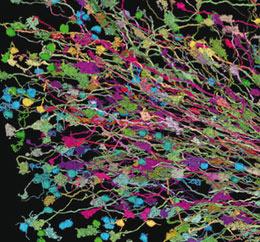
Somewhere over the (B)rainbow

Colours light up brain structure

Neuronal circuits can now be seen in a multicolour 'brainbow'.

A mix of 5 colours can produce about 90 distinct shades.


Nature (once again) has a wonderful paper about a new coloring technique able to randomly color every neuron with about 90 different shades so that their wiring can be seen more clearly.

Here it is, better written than I ever will be able to.

Did you really write that paper?

It happens sometimes that the job done by a single scientist get published with more than his name on it. He's usually the first author, except in Italy and other third world countries, where some professors pretend them to be on top. He's relegated to second place, unless the professor above has a favorite pupil who needs a push to get/stay into the tenure track.

Anyway, this post is not about unjust usurpation of authorship at the hand of elder academics. It is rather on the careless co-authorships practiced in some research groups, where all those belonging share authorships to any papers so as to augment their paper count in their CVs. Bad, bad practice indeed, especially when they happen to admit candidly during an interview "Oh, no, I didn't really know anything about that work, I was in the group so I got my name on it" - then why on earth did you insert it in your CV as relevant qualification, you dumb4$$?

I was shocked when a colleague recently said that after two years of work she had eight publications, plus countless posters and participations to meetings. needless to say, seven of those eight were of the aforementioned kind. And who on earth would care about which meetings and school you attended, unless you presented one at the first or were prized as best-in-class at the latters?

I try to put only first-author papers on my CV. which also implies it is desperately short. But at least I know I can defend that work with my claws, whereas if somebody is mifdly interested in me can always look up the other papers on pubmed or elsewhere and discover which fields I also happened to brush on. I probably know more than the average person in those, but don't claim nor brag to being an expert about them.

Why am I doing this post, you may ask? Oh, because Nature just came out with a similar theme this weekend. With a wider view than mine, in fact, covering the responsibilities of co-authors on the scientific accuracy of the papers, real-world cases and so on. Go and read it, it's certainly better than my rants anyway.

Wednesday, October 24, 2007

Who would have thought so?


Once again, Carl Zimmer surprises us: I thought he was concentrating solely on his soon-to-come book on E. Coli, instead he's busy on many fronts, the latest of which to come to fruition to us non-paying readers is his NY Times piece on migratory birds sleep. Check it out, as it is certainly worth. I, in my humble ignorance, would never have though that a bird could fly non stop for eight days. now, that's ENDURANCE.